Everyone agrees that for the possibility of conversion it is mutar. L'shem learning,
Tosafot says that it is always assur. Rambam and Meiri write that it is only assur when the non-Jew is using it to start a new religion. The Seridei Eish has famous teshuvah where he relies on this view to allow Torah lectures in university to non-Jewish students. The Midrash Tanchuma Parshat Noach suggests that only Torah Shebe'al peh is assur because of the covenental relationship between Hashem and Klal yisrael, but Torah She'bichtav is mutar.
Wednesday, March 7, 2012


Monday, March 5, 2012
Adar Madness: A Postscript
A really nice article on the final game of the tournament. Some highlights:
When someone peddles the script of Mirwis, Zach Yoshor and Isaac Buchine's run, they'll be asked to change the ending to something happier. The team that stood up for the Sabbath — and religious tolerance — the one that wouldn't stop believing even after it was told it would have to forfeit twice cannot get all the way to championship game and then lose, can it?
No one in TV or the movies is ever going to accept this.But in some ways, it's an even more perfect ending. For this was never about winning it all. It was about getting the chance to compete...

My 6- and 4-year-old sons will likely never be regulars at a synagogue.Once again, yasher koach. As a probably too big sports fan, it's nice to see a real kiddush Hashem on the court.
But I would have loved for them to see this Beren Stars team.
In victory. And even more in defeat.
Even as they wrestle with the emotions of falling just short in the big game, Mirwis and Co. could not be more complimentary to Abilene and its "stifling defense" and "great players."
Friday, March 2, 2012
Bayamim Hahem, Bazman Hazeh - Update on the Beren Academy Basketball Team
 They can play! This is a wonderful resolution to the story, now they just have to win it.
And thanks Rachel for the passionate & insightful comment (see below). I guess that's what happens when I don't edit my own writing, but I certainly did not mean to minimize the magnitude of what they did. It's a great and inspiring story.
Go Stars!
Tamar Berger (Maayanot '11) on the Parsha
This week’s Parsha is Parshas Tetzaveh. In this Parsha it says, “You shall command Bnei Yisroel that they should take for you pure olive oil pressed for illumination.” (27:20). The question on this Pasuk is why would the Torah say “For You” instead of saying “For Me” (for HaShem). Maschechect Menachos 86B (Gemara) says that this Pasuk makes complete sense and that the way the Pasuk is written is that way for a specific reason. The reason being that the Menorah is for YOU not for HaShem! That the light of the menorah is for YOU and NOT for HaShem!
It says in Mishlei that the mitzvot are shining lamps and that the Torah is light. Therefore just like HaShem says that the Menorah should be for our purpose and not His. So too should the Torah be for our purpose and not His. HaShem wants us to use the Mitzvos for our benefit. He wants us to use the mitzvos to get the most we can out of life.
There are two questions I have on this though. The first question I would like to ask is what does it mean that the Torah is for OUR purpose? I think this means that Torah is a present for us. This means that everything that HaShem gives us is a present. Therefore we can never be angry at Him or upset with Him and not follow His Torah because of how we feel towards HaShem. This is true because if we did not follow HaShem, HaShem would not love us less and He would not stop offering His present and asking us to take it but rather WE would not receive His present because we would say “No thank you” to it.
Last year Ma’ayanot brought in Rebbetzin Chana Reichman before Purim to speak about the chag. She said that the epitome of Amalek verses Klal Yisroel is the word Mikrah. She says that this word is of major significance because it can be read as Mikrah, coincidence, or Rak M’HaShem, only from HaShem. If we look at the Mitzvos as something that is a “coincidence” and boring we can be like Amalek but if we recognize that everything is a present from HaShem we will be able to receive that present and treat it as if it is a true gift. The gematria for Amalek is doubt and if we treat the Mitzvos as a coincidence and something that is not holy and something that is not special we will have more doubt and it will be harder for us to accept the Present. But if we recognize that the Mitzvos are a truly special gift. This will not be the case and we will truly serve HaShem to the best of our ability because we will recognize it is all for us.
My last question though is how do we look at Mitzvos in this way? What tools are we supposed to use to relate to Mitzvos as gifts. That I believe the second part of the Pasuk says. I believe that when the Pasuk says “Olive oil pressed for illumination” this also has a greater meaning. In the book Peninim on the Torah by Rabbi A.L Schneibaum, it says that the oil for the menorah was pressed in a light and delicate manner. As previously stated the Menorah is the Torah. This Sefer says that the reason why the oil was pressed delicately is because that is how we have to treat our students and their learning. We can’t just shove it down their throats, make them memorize, or make them abide by the laws that we wish them to abide by but rather we must present the material to them in a level headed manner. We must show them the preciousness of the Torah and with that hopefully they will truly learn the beauty of the Torah. We must show them the Torah is a gift and that the Mitzvos are for us!
Chevi Garfinkel says, HaShem can never love you more or less then he does but your relationship can be strained and your relationship can be weakened. HaShem is never going to take away the gift of His Torah. He is going to present it to us and we are going to decide if we want to accept it. He wants us to accept it more than anything but it is our gift and it is up to us what we want to do with it. We have to decide if we want the gift. We have to decide if we want to be close with our father.
Good Shabbos,
Tamar Berger
Why Command?
There is a concept in the Gemara "gadol ha'm'tzuveh v'oseh mi'she'eino m'tzuveh v'oseh" (the one who is commanded and does is greater than the one who is not commanded and does.) This is a concept that I have always pondered. Wouldn't you think that the one who volunteers is greater? The one who gives of her time. money, talent, skill WITHOUT being asked? Isn't altruism one of the greatest traits that a person can possess? Yet this concept is explained as follows: when one is commanded to do something, there is an automatic yeitzer to NOT do what has been asked. Being commanded violates our ultimate drive for control and our belief that we are each the masters of our destiny. So if Hashem commands something, and we STILL fulfill the command, we are both doing His will and pushing our own yeitzer away. It is a double act.
So who was greater--the Kohanim or Bnai Yisrael? Is a gift greater than a tax? Food for thought: tzedakah is actually a mitzvah. G'millut chasadim is rewarded. Are we really altruistic?
Shabbat Shalom
Mrs. Herzog
Thursday, March 1, 2012
Pre-Purim Reading Material

- First and Fohrmost, as many of you already know, last year I read what I consider by far the best analysis of the megila that I've read (my memory is poor enough that I now need to reread it), The Queen You Thought You Knew by Rabbi David Fohrman (it's cheaper on the OU website). Just read it.
- The year before, I really enjoyed Yoram Hazony's "The Dawn: Political Teachings of the Book of Esther." As you can guess from the title, it is a political analysis of the story.
- Finally (for now at least), YU's Purim To Go is generally a good read.
Wednesday, February 29, 2012
Adar Madness
We often hear stories of people of our grandparents and great-grandparents generation who gave up jobs and faced real economic hardship to keep Shabbat. In modern-day America these concerns have, thank God, all but evaporated. With that in mind, it was surprising but interesting to read about a Yeshiva high school in Houston who is missing its playoffs because it insists that they won't play on Shabbat.


The Robert M. Beren Academy, an Orthodox Jewish day school in Houston, won its regional championship to advance to the boys basketball state semifinals this weekend in Dallas. But the team will not make the trip.I don't think anyone is doing anything particularly evil or heroic here. I would like to think that in a similar situation other Yeshivot would reach a similar decision. And while we have gotten used to larger organizations accommodating our special religious needs (SATs, universities, most workplaces), in many instances they aren't obligated to. Still, while I feel bad for the players to be missing out on the opportunity that they worked so hard for, in a way they got an opportunity to put their money where their mouth is and demonstrate the kind of religious commitment to Shabbat that for the rest of us is just theoretical. Yasher koach to the whole school (especially Rabbi & Dr. Pollack - a Ma'ayanot connection! Keep up the great work.)
Beren Academy's basketball team had hoped to travel to Dallas early and play its semifinal game before sundown on Friday.
The Beren Academy players observe the Sabbath and do not play from sundown on Fridays to sundown on Saturdays. Their semifinal game is scheduled for 9 p.m. Friday.
“The sacred mission will trump excellence in the secular world,” Rabbi Harry Sinoff, Beren’s head of school, said Monday in a telephone interview.
Monday, February 27, 2012

Friday, February 24, 2012
Thoughts on the Parsha with Tamar Berger (Maayanot '11)
#1- Love Mitzvos- “And let them take for Me a portion, from every man whose heart motivates him.” (25:2). Many Mefarshim comment on this Pasuk and ask the question, what does it mean that we should “take for Me a portion”? Shouldn’t it be give?
Rav Dessler says in his SeferMictavM’Eliyahu that a person that gives will love more. A person that invests in something will love the item more than the person who takes from something. This is like a mother and child relationship in which the mother gives and the child takes. In this relationship the mother loves the child more than the child loves the mother because the mother gives more to the child than the child gives to the mother.
This concept is also true to the Mishkan and to all Mitzvos. If we invest ourselves into the Mitzvos, than they will mean more to us instead of us just taking from HaShem. If we invest in our relationship to HaShem, then our relationship to HaShem will then mean more to us.
That is why Rav Schlessinger explains that when it says “Take for me a portion” it truly means take even though the person would be giving. This is because the true form of taking is to give and our relationship only becomes stronger if we give rather than if we take.
#2- Inspiration- The context of the Pasuk above is that it was said, according to some Mefarshim, right after Na’aseh V’Nishma (24:7) was said.
The Baal Shem Tov says that this is extremely important to recognize. This is because right after we said to HaShem that “we will do and we will listen” (which by the way I love because it is not that we will listen and then do, notice the order, we must follow HaShem regardless of our own feelings towards a Mitzvah) we followed what we said and we did exactly that. We built a home for HaShem, a place that is filled with such Kedusha.
This is important because we acted with zrizus. We took our inspiration and ran with it. We realized that we were inspired and we listened to that inspiration and followed HaShem’s commands. We acted immediately. We took action.
#3- Help from HaShem- “You shall make a Menorah of pure gold, hammered out shall the menorah be made, its base, its shaft, its cups, its knobs and its blossoms shall be hammered from it.” (25:31)
Rashi comments on this Pasuk, which begins “You shall make a menorah” and ends with “shall the menorah be made”, and says that this is because HaShem asked Moshe to do something that was impossible for man to do. HaShem asked Moshe to make the Menorah all together. God instructed Moshe to put it in the fire and the Menorah through this emerged into the correct form. This is because HaShem made it that way.
HaShem saw it was impossible and therefore HaShem helped Moshe and told Moshe that if Moshe put it in the fire HaShem would form it to be a Menorah. HaShem knew that Moshe was not going to be able to do it and therefore HaShem finished the product. Moshe went the first half and HaShem finished him off.
#4- Build a House for HaShem- “They shall make a sanctuary for me, so that I shall dwell among them.” “Va’asu Li Mikdash V’SchnatiB’Tochem” (25:8)
Shelah HaKodesh says that this Pasuk truly means within them. He says that B’ means within and therefore this Pasuk is saying HaShem shall dwell within them.
Each person MUST have a Mikdash Ma’at (small temple) in themselves. We must each have that place, that home, for HaKadoshBaurch Hu within us and we must reach and nurture that place.
I think that the previous 3 actions help us do that. With the love that we have from doing Mitzvos and taking the responsibility of doing the Mitzvah, from the inspiration we get to put forth and do Mitzvos, and from our help from HaShem we really can build and nurture that Mikdash inside of us and have it blossom.
May we all merit seeing the coming of the Beis HaMikdash through the building of our Mikdashim inside of all of us.
Good Shabbos,
Tamar Berger
Tuesday, February 21, 2012
The Amazing (but assur?) Race: Reality TV & Halacha
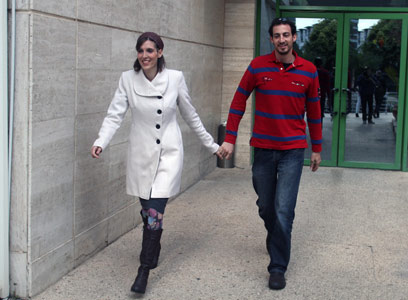
"The exposure in itself isn't modest. A man must be modest and humble; he shouldn't have a video camera follow him and see what he does."
"We're not that modest, and sometimes we take pride and behave in such a certain way as to make an impression. We're not okay and may God have mercy on us," the rabbi said. "But here we see a man who invited the television crews on purpose and they follow him and his every move...that's the opposite of being modest."
Monday, February 20, 2012
Why-aanot's Greatest Hits - Choosing a College
It started with a long post by Mrs. Knoll about the advantages and disadvantages of Stern as compared to other college campuses. Mrs. Sinensky followed up with a response. Then the students started getting involved. Jennifer Herskowitz made a passionate defense of her decision to apply to Stern, but then Rachel Friedman immediately responded to all of the Stern love, playing devil's advocate (I would be fascinated to hear, now that they are both where they thought they would be, if they would amend any of their comments. Interested in a follow up). Ms. Appel (who chose to go to Penn) and Ms. Wolf (who switched from Stern to Barnard) added their unique perspectives. I then piped in as "the only one in the discussion who couldn't have gotten into Stern," and promptly brought an end to the conversation. Hope you find the discussion helpful even if it ultimately complicates your decision making process. Good luck (and enjoy the vacation).
Sunday, February 19, 2012
What Inspires Me - Zisse Hanfling
A while ago we introduced the "What Inspires Me" program, in which we will be sharing our personal inspirations and hopefully inspire others as well. I started by reading a passage from Rabbi Yisrael Meir Lau's newly translated memoir, "Out of the Depths" (go here and search inside the book for Naboth - go back to page 162 and read the story about his Rebbi Rav Shlomo Zalman Auerbach).
Here is our second installment - Zisse shared this with the school after tefilla last week but agreed to write it up for the blog. Yasher koach.
Here is our second installment - Zisse shared this with the school after tefilla last week but agreed to write it up for the blog. Yasher koach.
This video is of Ayelet who was two years old and was diagnosed with a rare bone marrow disorder.I got the idea to show this video to you because a friend of mine from who did a really special act. She took an initiative.... she went to ayelets shiva, and I was so impressed how she was so moved by ayelets story and I thought if this one girl can make a diffence and an impact on me that she took this step of kindness -Maayanot as a school can make a diffence together.I'm going to read a part of the article that I found written by the Rabbi from the Harvard Hillel about Ayelet Z''l, its to your benefit to listen:The loss of Ayelet is not just the loss of one beautiful little girl. It is not just the loss of the potential for her life and all that she might have accomplished. It is both of those things but also so much more. Sanhedrin teaches us that the loss of a single life is as if an entire world was lost forever. There are generations of descendants from Ayelet the world will never know. There are countless people who would have been touched by her life who will not have that experience. In chaos theory there exists a concept called the butterfly effect in which one small change can bring about tremendous results that would be impossible to anticipate. The loss of Ayelet is not just a small change to the world, it is an enormous change, and the impact that she would have brought to her family, her people and the rest of humanity, will never be known.Yet, the Mishnah also teaches us the converse as well. One who saves a life is as if she or he saved the entire world. And there is no doubt that the heart wrenching struggle for life waged by Ayelet and her family, broadcast to the world has brought about so much good. One often wonders how much they can truly impact the world. What difference can I really have in a global community of over seven billion people? The story of Ayelet is the loudest protest possible against the proposition that our lives do not and cannot matter. Each one of us can make such a tremendous difference.Countless cheek swabbing drives to add people to the bone marrow registry.... Because of those cheek swabbing drives, when Ayelet tragically left this world on Monday morning, 21 people had found their lives saved through the bone marrow registry and the registration of all those new people. Twenty one people in this world owe their lives to the good will of complete strangers who were inspired at the very deepest levels to act because of Ayelet Galena zt”l. In other words, because of Ayelet there now exists another twenty one worlds of human life and meaning.This is the impact of one person. -Anytime you feel your life does not matter, anytime you are confident that the world would be no worse or better with or without you, remember Ayelet. The struggle of one small child restored life to twenty one people. Ponder and reflect on that because you never know how and in what way you will make that difference.Each one of us can make a differenceI say we dedicate our learning on Februray 9th in memory of Ayelet Galena.There are countless people whom I'm sure have done so much for her, and Maayanot can do that to! It might not be money and it might not be saving a life, but as a Yeshiva is shows that highschool girls can take an initiative.This special girl and her family impacted me in ways I couldn't have realized before.There grace and humor through this hard struggle is what made me want to this share this with you. To look at life through a positive light is so much more fulfilling than anything in the world. There small positive outlook on their young child even reached celebrities. I believe whole heartily ou can make a difference to the girl sitting next to you…just by being the awesome you- and as a growing teenage girl you should never forget that…My step of standing up here is not what is going to change your life. But me standing up here telling you that you can change someone elses life is what im hoping to accomplish. Maayanot feeds us the skills to grow into a adult throughout high school- and as adult women going out into the world soon- we all matter and we all can make a difference- if a two year old can do it i'm sure we can all to!
Friday, February 17, 2012
Something Fishy (or Wormy)
Back to the NYT for a true example Toraha U'mada:
Just so you know: Canned sardines are kosher.
This judgment would appear to be definitive, based on DNA evidence. Genetic testing by a parasitologist at the American Museum of Natural History has confirmed that the recent discovery of small worms in canned sardines does not render them treyf, or unkosher. It may render them unappetizing, but that judgment is up to the consumer (more on that later).
The museum got involved last March when rabbis from the Orthodox Union, which certifies as kosher hundreds of thousands of products across the world, sought scientific help in resolving a question that arose when they began finding the worms, or nematodes, in cans of sardines.
The Lonely Man of Lin
Ascent in the sports universe is a straight shot. You set your goal, and you climb toward greatness. But ascent in the religious universe often proceeds by a series of inversions: You have to be willing to lose yourself in order to find yourself; to gain everything you have to be willing to give up everything; the last shall be first; it’s not about you.But then check out his big finish!
For many religious teachers, humility is the primary virtue. You achieve loftiness of spirit by performing the most menial services. (That’s why shepherds are perpetually becoming kings in the Bible.) You achieve your identity through self-effacement. You achieve strength by acknowledging your weaknesses. You lead most boldly when you consider yourself an instrument of a larger cause.
The odds are that Lin will never figure it out because the two moral universes are not reconcilable. Our best teacher on these matters is Joseph Soloveitchik, the great Jewish theologian. In his essays “The Lonely Man of Faith” and “Majesty and Humility” he argues that people have two natures. First, there is “Adam the First,” the part of us that creates, discovers, competes and is involved in building the world. Then, there is “Adam the Second,” the spiritual individual who is awed and humbled by the universe as a spectator and a worshipper
Soloveitchik plays off the text that humans are products of God’s breath and the dust of the earth, and these two natures have different moral qualities, which he calls the morality of majesty and the morality of humility. They exist in creative tension with each other and the religious person shuttles between them, feeling lonely and slightly out of place in both experiences.
Jeremy Lin is now living this creative contradiction. Much of the anger that arises when religion mixes with sport or with politics comes from people who want to deny that this contradiction exists and who want to live in a world in which there is only one morality, one set of qualities and where everything is easy, untragic and clean. Life and religion are more complicated than that.
Thursday, February 16, 2012
Why is Mishpatim HERE?
"Yeish mukdam u'm'uchar ba'Torah oh ein mukdam u'm'uchar ba'Torah?" This is a debate that begins in the Gemara, but really finds its footing in parshanut. The fundamental question is whether or not the Torah is arranged in strict chronological order. Ramban consistently adheres to the former (the Torah follows along chronologically) and Rashi agrees with the latter (the Torah does not necessarily follow chronology). Regardless of where one falls in this debate, the beginning of this week's parasha indicates that it is, in some fundamental way, connected to last week's.
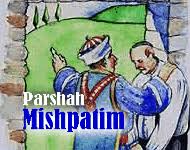
"V'eileh ha'mishpatim"-- And these are the laws. The "vav" that begins that parasha is not a "vav ha'hipuch" because "eileh" is not a verb to be transformed from one tense to the other. Rather, it is a "vav ha'chibur"--a connecting vav. So the first question that must be asked is: What is the connection of this wek's parasha to last week's parasha? Is it that this is the next set of laws that Moshe received from Hashem? If so, was he still on Har Sinai when these were spoken? These questions begin a whole line of questions as to what was said on Har Sinai, what wasn't, what was said at this moment, what was said later, and what Moshe was taught by Hashem during which stint on Har Sinai.
Which brings up another s'michut question: What is the connection between the dibrot, how the mizbei'ach is to be built (with a ramp, not stairs so that the privates of the kohein are not revealed as he walks up) and the laws of Eved Ivri? If the point that the Torah is trying to make is to show that all halacha is, in effect, "bein adam l'makom", then why pick these two to follow the Dibrot? If the mizbeach is parallel to the first five dibrot, then why end the parsha there?
Regardless of where one stands on the yeish/ein mukdam argument, an interesting question arises. In beginning this parasha, the first set of laws discussed are the laws of Hebrew slaves. Bnai Yisrael had just left slavery; the first dibrah forever reminds us that Hashem is the Power that took us out of Egypt "from the house of slavery." Why would slavery even be permitted in Judaism? And why would it be (almost) the first law mentioned after the Aseret HaDibrot?
Finally, if we are all "avadim" only to Hashem, then why does a parasha that is primarily about civil law begin with permission for us not only to own other humans, but other Jews?
Shabbat Shalom!
Mrs. Herzog
Wednesday, February 8, 2012
Kabed et avicha v'et imecha
Victor Frankl (1905-1997), author of Man's Search for Meaning and founder of logotherapy, a field of psychotherapy based on finding meaning in life, writes about his encounter with this mitzvah just before World War II.
Having just gotten word that his visa to leave war-stricken Europe had arrived, Frankl found himself torn between taking the opportunity and staying to care for his older parents. Very much stressed by the decision, he decided to put it on hold and wait some sort of sign from Above for guidance.
When he got home that day he saw his father sitting at the table and noticed a big block of stone resting on the table. "What's that?", he asked. His father told him he found it at the site of a nearby shul that had been destroyed by the Nazis. "It has on it", his father told him, "a reference to one of the 10 commandments". Victor asked his father which one. "The 5th one, to honor one's parents".
He had found his sign.
His book is difficult to read, as all Holocaust books are, and is really insightful.
Having just gotten word that his visa to leave war-stricken Europe had arrived, Frankl found himself torn between taking the opportunity and staying to care for his older parents. Very much stressed by the decision, he decided to put it on hold and wait some sort of sign from Above for guidance.
When he got home that day he saw his father sitting at the table and noticed a big block of stone resting on the table. "What's that?", he asked. His father told him he found it at the site of a nearby shul that had been destroyed by the Nazis. "It has on it", his father told him, "a reference to one of the 10 commandments". Victor asked his father which one. "The 5th one, to honor one's parents".
He had found his sign.
His book is difficult to read, as all Holocaust books are, and is really insightful.
Thursday, February 2, 2012
It's Groundhog Day
This "holiday" (HEC, where are you) is a harmless if silly American tradition, but it is the back drop for one of the more thought-provoking and religiously / philosophically interesting movies that I've ever seen (by the same name).
Below is the beginning (not too much in terms of spoilers) of the Wikipedia plot summary. If you're ever looking for something to watch, this comes highly recommended.
Self-centered and sour TV meteorologist Phil Connors (Bill Murray), news producer Rita (Andie MacDowell) and cameraman Larry (Chris Elliott) from fictional Pittsburgh television station WPBH-TV9 travel to Punxsutawney, Pennsylvania, to cover the annual Groundhog Dayfestivities with Punxsutawney Phil. Having grown tired of this assignment, Phil grudgingly gives his report and attempts to return to Pittsburgh when a blizzard shuts down the roads. Phil and his team are forced to return to Punxsutawney and stay in town overnight.
Phil wakes up to find that he is reliving February 2. The day plays out exactly as it did before, with no one else aware of the time loop, and only Phil aware of past events. At first he is confused, but, when the phenomenon continues on subsequent days, he decides to take advantage of the situation with no fear of long-term consequences: he learns secrets from the town's residents, seduces women, steals money, drives recklessly, and gets thrown in jail. However, his attempts to get closer to Rita repeatedly fail.
Eventually, Phil becomes despondent and tries more and more drastically to end the time loop; he gives ridiculous and offensive reports on the festival, abuses residents, eventually kidnaps Punxsutawney Phil and, after a police chase, drives into a quarry, evidently killing both himself and the groundhog. However, Phil wakes up and finds that nothing has changed; further attempts at suicide are just as fruitless as he continues to find himself awaking at six o'clock on the morning of February 2 with the clock radio on his nightstand playing "I Got You, Babe" by Sonny & Cher, as on each previous day.
Wednesday, February 1, 2012
Racism Towards Muslims in Israel? Exposed with Hidden Cameras
This is the headline I saw on the video forwarded to me by my sister. I had the same feeling I've had occasionally, when someone Jewish does something that embarrasses the rest of us. The power of a chillul Hashem is enormous, and all of us feel it. More so when it is done ostensibly in the name of religion (I feel the shame of Beit Shemesh & Baruch Goldstein far more than Bernie Madoff - a criminal who happens to be Jewish). Then I watched the video - check it out for yourself.
Friday, January 20, 2012
Thoughts on the Parsha
Even though we're on vacation, a couple of thoughts. First an old one from the first month on the blog three years ago:
Reviewing the Parsha with my head already on vacation, I was struck by a certain passage. When defending themselves to Paro, the heroic midwives defend themselves with a statement that would serve us well to remember as we head to our various exotic & less exotic destinations: כִּי לא כַנָּשִׁים הַמִּצְרִיּת הָעִבְרִיּת - The Jewish women are not like the Egyptian women. As integrated as we are into our American culture, with all of the benefits - of all types - that we get from it, it's important to keep in mind that we are different, and that should be evident for all to see.Since that was last week's Parsha, I'll give over a nice dvar Torah I received from my neighbor, Rabbi Dan Lifshitz:
"This was the Aaron and Moshe to whom G-d said take the Children of Israel out of Egypt.... This was Moshe and Aaron." (Exodus 6:26-27)
Rashi explains that the transposition of the names between the first verse and second verse indicates that the two brothers were equal in status. The Shelah asks a fairly obvious question on this explanation. The Torah later tells us "there never again arose a prophet in Israel like Moshe (Deut 34:10)." If so, how does Rashi tell us that Aaron was his equal? The Shelah answers that Moshe developed over time. When he first went with Aaron to speak with Pharaoh, the two of them were on par, but by the time Moshe went up on Mount Sinai to receive the Torah, he had become the greatest of the prophets.
The Ktav Sofer suggests a reason for Moshe's "promotion." Moshe was known for his humility. When he was a simple shepherd tending Yitro's sheep in the desert, it was easy for him to be humble. When he first approached Pharaoh's palace together with his brother, it was still relatively easy. But after Moshe brought plagues upon the Egyptians, after he stood up to Pharaoh, after he became "very great in the land of Egypt, in the eyes of Pharaoh's servants and the people (Exo. 11:3)," most people would have become prideful to some extent. To Moshe's credit, his head never got bigger, even as his accomplishments grew more and more impressive. By maintaining his humility in the face of his rise to greatness, Moshe earned the position of the "master of the prophets." Humility is not the most celebrated trait in today's world, but in G-d's eyes, it is cherished indeed. Shabbat Shalom
Subscribe to:
Posts (Atom)